Ask Ten People What Your Company Does
There’s a finding in Kahneman, Sibony, and Sunstein’s book Noise that has stuck with me since I first heard the authors discuss it. When leaders are asked how much variability exists in the judgments their organization produces (e.g., two underwriters pricing the same policy, or two managers rating the same employee) they tend to guess around 10%. When someone actually measures it, it’s usually north of 50%.
Five times the scatter the people running the place believe is there.
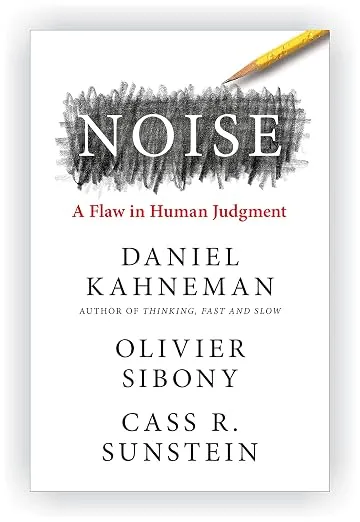
The authors call the cleanup work “decision hygiene,” and the fix for this kind of noise is well understood: break a complex judgment that used to rest with one person into many independent judgments made by different people, then aggregate. HR does this with 360-degree reviews. Computer vision training has been crowdsourced this way for years (every CAPTCHA asking you to pick out the crosswalks is running exactly this play).
What interests me, however, isn’t so much the fix. I find the size of that gap between assumed and measured much more interesting, because I see the identical gap somewhere the authors weren’t looking: in how a company describes itself.
The test
Ask ten people to finish one sentence, in their own words: “We help ___ do ___.”
Pick the ten deliberately. Your co-founder, your head of sales. An engineer who started six weeks ago, or someone in support who talks to customers all day. A board member. Your best customer, if you’re brave. Ask them separately, in writing, and don’t let them see each other’s answers. (The moment they can confer, you’d be measuring conformity instead of clarity.)
Then put the ten sentences in one document and read them out aloud next to each other.
Most executives predict a bit of variation in wording around a shared core. What usually comes back is three or four genuinely different companies.
Why the scatter is expensive
Every one of those ten people is doing your marketing. The sales rep improvises a new framing on each call because no supplied one survives contact with a skeptical buyer. The engineer explains the company differently at a meetup than the founder does on a podcast. Support describes the product by what it fixes; sales describes it by what it costs.
A buyer talking to three of your people hears three companies. And a buyer who can’t tell what you are falls back on the one axis that’s always legible: price. That’s not a messaging failure downstream of the real problem. That is the problem, and it’s the one we built the Positioning Stress Test around.
The scatter also compounds internally: prioritization arguments that look like disagreements about roadmap are usually disagreements about what business everyone thinks they’re in. You can’t resolve those with a planning process, because the participants aren’t actually arguing about the thing they seem to be arguing about.
Where the analogy breaks (and why that matters)
For noisy judgments, aggregation works: when you collect independent estimates, then average them, the errors cancel. More opinions make the answer better. That is the wisdom of the crowd at work.
For positioning, aggregation actively fails: average your ten sentences and you get a sentence with every specific detail sanded off: the exact mush that produces “leading provider of innovative solutions.” Everyone recognizes their contribution in it, and while the meeting room is happy, no buyer can do anything with it. The wisdom of crowds turns into the vocabulary of no one.
Noise in judgment is a measurement problem, and you fix it with more measurements. Noise in positioning is a decision problem, and the only thing that fixes it is someone deciding, and then writing the decision down in language specific enough that a new hire can use it without a meeting.
That’s what a North Star document is. Not a mission statement, not marketing copy: the decision, recorded, in a form people can act on when nobody senior is in the room. It’s the artifact almost every engagement we run produces, whatever else changes.
Run the test first
We’re happy to help but you don’t need us to do the diagnostic part. Send the sentence to ten people this week and lay the answers side by side. If they converge, you have a real asset and you should be defending it more deliberately than you probably are.
If they scatter (and if the scatter is wider than you’d have guessed, which is the whole point of the Noise finding) then you’ve found the thing that’s quietly costing you deals. That’s where we’d start.