Extraordinary Companies Have Fans
Two years ago, I promised on LinkedIn (opens in a new tab) to write a post about Aristides Instruments “in the next few days.” It took juuuust a little longer than that.
To start, a quick disclosure: Aristides isn’t a client of ours (though I’d like them to be). Instead, I’m a client of theirs. I paid for all four of the guitars I own, and there will be more. That makes this an observational case study: I’ve been to their factory often enough, for open houses and on regular workdays, to have seen the whole shop at work, buzzing. I haven’t done any formal research, so what follows are casual observations, reinforced every time I’ve gone back.
Fans, not customers
Every company has customers, but the extraordinary ones also have fans. Fans talk about your products without being asked, they feel like they’re part of the crew, and they’re the ones who keep sending your customer service team feature ideas and minute bug reports. (Embrace them!) Customers need to be convinced one at a time, over and over again, while fans do a lot of that convincing for you.
Aristides is the best example I know of such a company, and I’m very much one of their fans.
How they turned me into a fan
At first, it was simply their work. I had heard about Aristides from an acquaintance in metal circles, which is where most of their following comes from, so I reached out and ordered a fairly basic first build to see whether I would like their work. If I didn’t, it was a plain black guitar I could easily resell. I liked the looks, playability and feel enough to want something much more personal for the next one.
Specifically, I wanted a sparkle finish over a chameleon paint job, which they had never done before, and painted pickups, which they didn’t want to do at all, for quality reasons: paint can chip off the edges of pickups over time, and they didn’t want me, their customer, to be disappointed if that happened one day.
So we discussed it, back and forth, and I pushed and coaxed them until they agreed. As it turns out, they actually enjoy it when customers recognize what they’re capable of and push them beyond what they’ve done before. Their website even encourages you to send in your crazy idea, because “it might just be crazy enough for our paint team!”
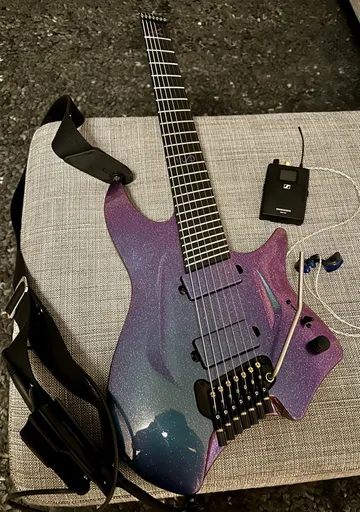
That guitar is one of their headless seven-strings, an H/07. I ordered it in 2021 and have had it since 2023 (the time in between was the build time and all that back and forth). Aristides featured it on their Instagram account and in their gallery (opens in a new tab), where you’ll find far more detailed shots in much better light than mine, and since then other customers have ordered the same finish or something inspired by it.
Throughout all of this, every interaction was personal and professional, with a lot of openness and trust in both directions. And it goes beyond the guitars: over the years, I’ve been to their factory open days, had pizza and coffee with the team, and even attempted some karaoke with Pascal, their CEO (he’s much better at it than I am).
Robots for the boring parts
Aristides has grown over the years, too, and at some point they brought a robot arm into their workshop in Haarlem to help their luthiers work more efficiently. It takes on the boring work that has no impact on how an instrument looks or feels, while people still do everything that does, and they’re still the ones you talk to as a customer.
That balance only works because they know exactly what their company is about, which also tells them where a machine can help without taking anything away. Companies that are less sure of that (or, worse, have no idea!) tend to decide it one cost-cutting measure at a time, until they’ve automated away whatever it was that turned their customers into fans.
What any company can learn from them
Say no when it protects the customer, and let a good argument change your mind. Their first answer on the painted pickups was no, because they cared more about how I’d feel about my guitar years from now than about the order in front of them. When I made my case, they listened, and they agreed. I learned more about the company from those two answers than from anything on their website.
Let your fans push you further than you’d go on your own. Customers like me aren’t the only ones who push them. Paint jobs are one thing, but conversations with Mike Stringer of Spiritbox led Aristides to develop what they describe as the world’s first true multiscale EverTune, and after nearly a decade of working together, they designed an entirely new offset guitar with him, the STX series.
Aristides calls the STX an artist collaboration line rather than a signature model. A signature model usually puts a player’s name on a guitar that already exists; this one was designed with him from the start, and any customer can now order it. Fans only bring ideas like that to a company they believe can pull them off, and a company that takes those ideas seriously gets more of them.
Give people a reason to show up. People want to belong to something bigger than themselves, something meaningful and fun, and the open days are how Aristides lets customers and employees mingle. When the people who build the guitars share stories with the people who buy and play them, the team hears what their work means first-hand instead of through a sales report. It runs both ways, and both sides end up giving more than the job or the purchase asks of them.
Treat your own team well. When it’s time for a break at Aristides, there’s often a pick-up soccer game in the yard between their factory buildings. It’s the kind of ritual that organizational culture is made of. Many of the people on that field are the same people customers deal with, and as a customer, you can tell when the people you’re dealing with enjoy where they work. This isn’t a guitar thing. When Dunkin’ wanted to know why one franchise in Asheville had the lowest staff turnover in their national system, we embedded with that team and found the answer in their managers.
What to do with this
You can do all four at your own company, and none of them needs a robot or a band. All you need is one answer to “what is this company about?” Everyone at Aristides knows theirs, so the painted-pickup decision, the robot decision and the STX decision all line up in a coherent way. That answer is the key, and there’s a quick way to find out whether your company has it: ask ten people what your company does and lay the answers side by side. If they match, defend that. If they don’t, then you have your work cut out for you. (If you want help, we’re happy to talk.)